

Why Garage Floor Coatings Fail in South Florida
It's almost never the coating. It's what was under it when it went down.
By Epoxy & Beyond · Climate & Prep · September 20, 2026
Quick answer
Why do garage floor coatings fail in South Florida?
In South Florida, garage floor coatings that bubble or peel usually fail because of moisture moving up through the slab, not because of the coating itself. A water table close to the surface pushes moisture through porous concrete. It collects under the coating and breaks the bond. The slab should be evaluated before a price is finalized.
Related services: Garage Floor Coatings, Modular Tile Flooring
Bubbling and peeling usually start below the surface
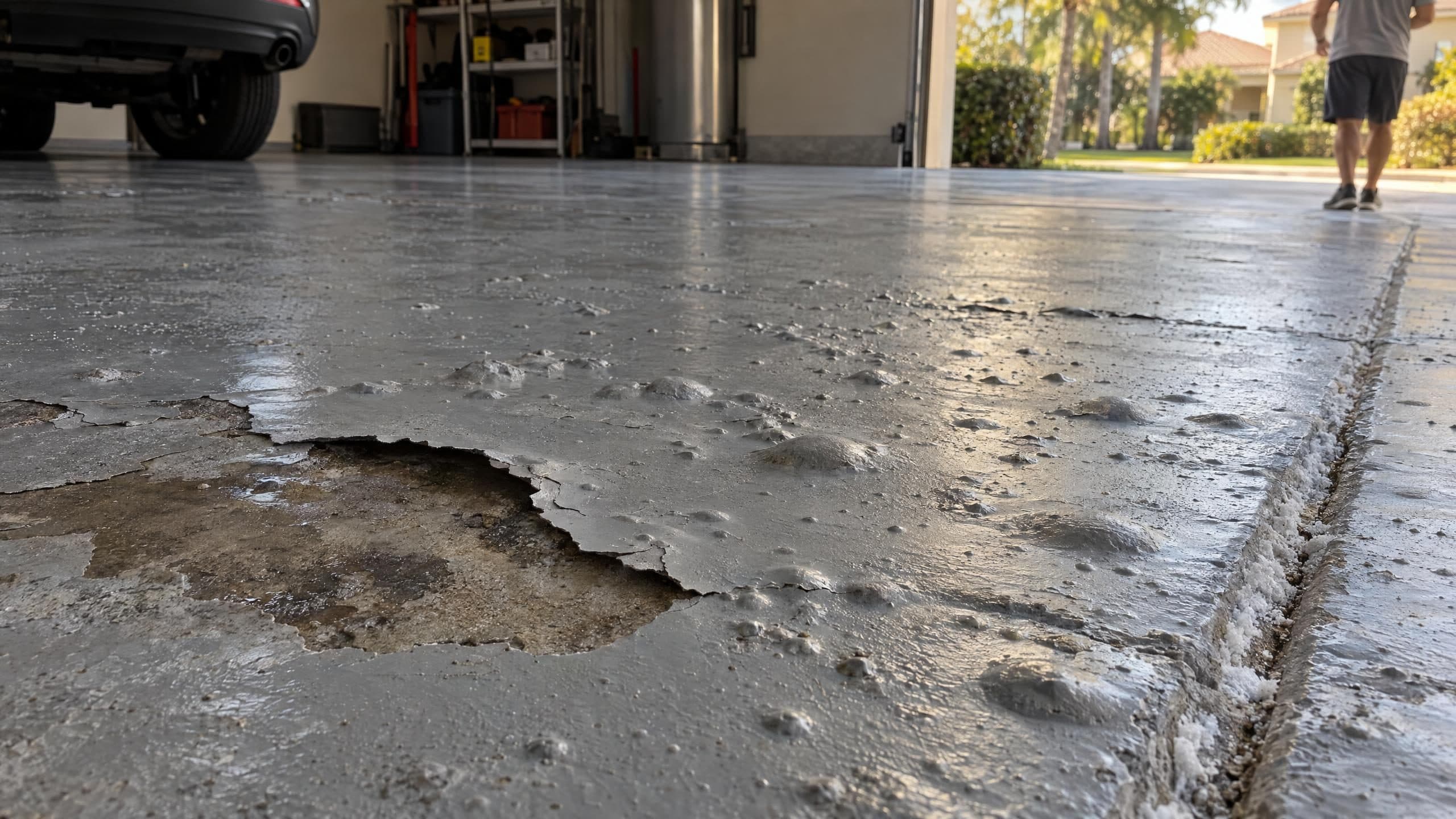
When a garage floor coating bubbles, peels, or goes soft in patches, the instinct is to blame the coating — wrong product, cheap material, bad batch. In South Florida, the more common cause is what was happening underneath the coating before it ever went down: moisture moving up through the slab.
Concrete is porous. Water in the ground doesn't stay in the ground — it moves upward through capillary action, a process called vapor drive. In much of South Florida, the water table sits close to the surface, so that upward pressure is a constant, not an occasional event after heavy rain.
Why this shows up more here than elsewhere
A coating is essentially a sealed layer bonded to the concrete. If moisture is pushing up through the slab when that seal goes on, it has nowhere to go. It collects underneath the coating, breaks the bond, and eventually pushes the coating up in bubbles or blisters, or turns it soft and slick. This can take weeks to show up, which is exactly why it's easy for a contractor to be gone before the problem appears.
Older slabs, garages near canals or low-lying lots, and homes close to the coast are more exposed to this, but it isn't limited to any one neighborhood. New construction on a well-compacted, properly cured slab can still show elevated moisture readings, and a decades-old slab can test fine.
 Concept
What a moisture check actually looks like
- The slab should be evaluated before a price is finalized, not assumed to be fine.
- If a reading comes back high, a straight answer about what that means for your options — not a coating applied anyway and a warranty that quietly doesn't cover moisture damage.
- Mechanical surface preparation, not just a solvent wipe-down, so the coating has something to actually bond to.
- A plan for crack and joint repair before coating, since a crack under a coating usually telegraphs back through eventually.

How Epoxy & Beyond handles it
We check the slab before we quote a job, not after we've already sold it. If conditions aren't right for a coating as-is, we'll tell you that directly and talk through the options rather than coat over a problem and let it show up later. It's a slower first conversation, but it's the difference between a floor that holds up and one you're calling someone about again in six months.