

Best Garage Flooring Options for South Florida Homes: Epoxy vs. Other Flooring Systems
There isn't one right answer here — there's a right answer for your garage.
By Epoxy & Beyond · Buyer's Guide · September 21, 2026
The decision most homeowners get backwards
Most garage flooring research starts with a product — "is epoxy good?" — instead of a question that actually narrows things down: what does this floor need to do, and for how long do you plan to live with the answer? A garage that stores two commuter cars and holiday decorations has different requirements than a garage that doubles as a workshop, a home gym, or a wash bay for a weekend car.
This is a rundown of the systems homeowners in South Florida actually choose between, what each one is genuinely good and not-so-good at, and the questions worth asking yourself before you ask a contractor for a quote.
Bare concrete and concrete sealers
Bare concrete is the default, and it's not nothing — a well-finished slab can look fine for years. It's also porous, so it absorbs oil, tire marks, and moisture, and it dusts over time as the surface wears. A penetrating sealer slows that down without changing the look much: it's the lowest-cost, lowest-commitment option, and it's a reasonable choice for a garage that's purely storage and gets minimal traffic.
What it doesn't do is hide flaws, resist hot-tire pickup the way a bonded coating can, or give you a decorative finish. It's maintenance-light because there's very little floor to maintain in the first place.
Garage floor tiles
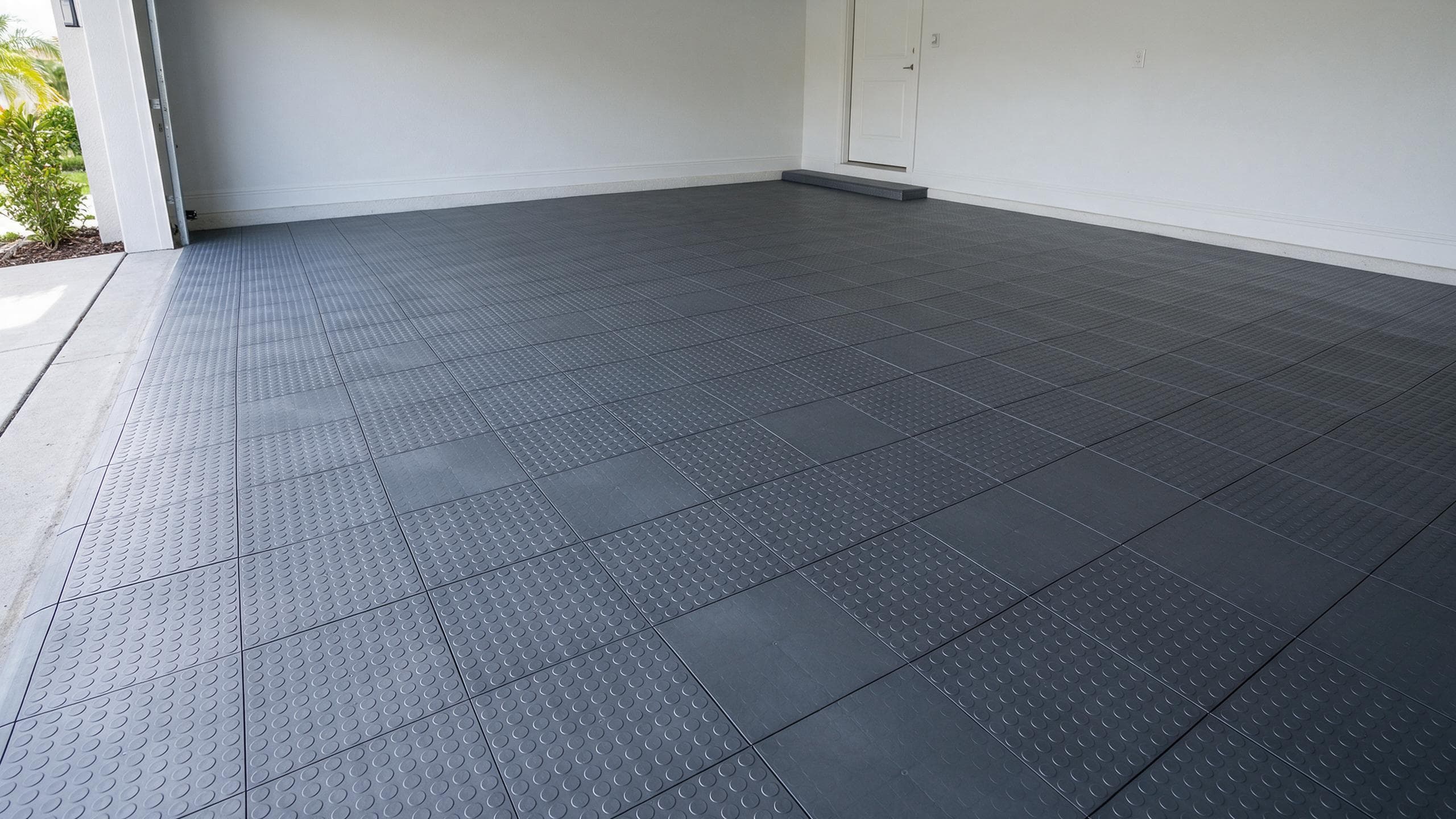
Interlocking PVC or polypropylene tiles sit on top of the existing slab rather than bonding to it. The appeal is speed and reversibility — no grinding, no cure time, and you can pull them up later. The tradeoff is that they're not bonded to the concrete, so moisture and debris can work their way underneath over time, and heavy, stationary loads (a lift, a workbench with steel legs) aren't always ideal on a floating floor system. Tiles are a legitimate option for a renter, a garage used seasonally, or someone who wants a quick refresh without committing to a coating.
Epoxy and polyaspartic coatings
These are bonded systems — the coating is mechanically and chemically adhered to a properly prepared slab, not sitting on top of it. That bond is what gives a coated floor its durability and its sealed, low-maintenance surface, and it's why prep (grinding, crack repair, a moisture check) matters more here than with any other option on this list: a coating is only as good as what it's bonded to.
Epoxy and polyaspartic are two different resin chemistries with their own tradeoffs in cure time, UV response, and working time — covered in detail in our side-by-side comparison linked below rather than repeated here. Both give you a wide decorative range (solid color, flake, metallic) and the most durable, sealed surface of the options in this article.
How to actually decide
- How is the garage actually used — parking only, a workshop, a home gym, a wash bay?
- How long do you plan to be in the home, and does that change what's worth investing in?
- Is the slab in good condition, or does it have visible cracks, stains, or moisture signs that need addressing regardless of the finish you choose?
- Do you want the ability to change or remove the flooring later, or are you installing for the long term?
- What's your appetite for a one-time project versus periodic upkeep?